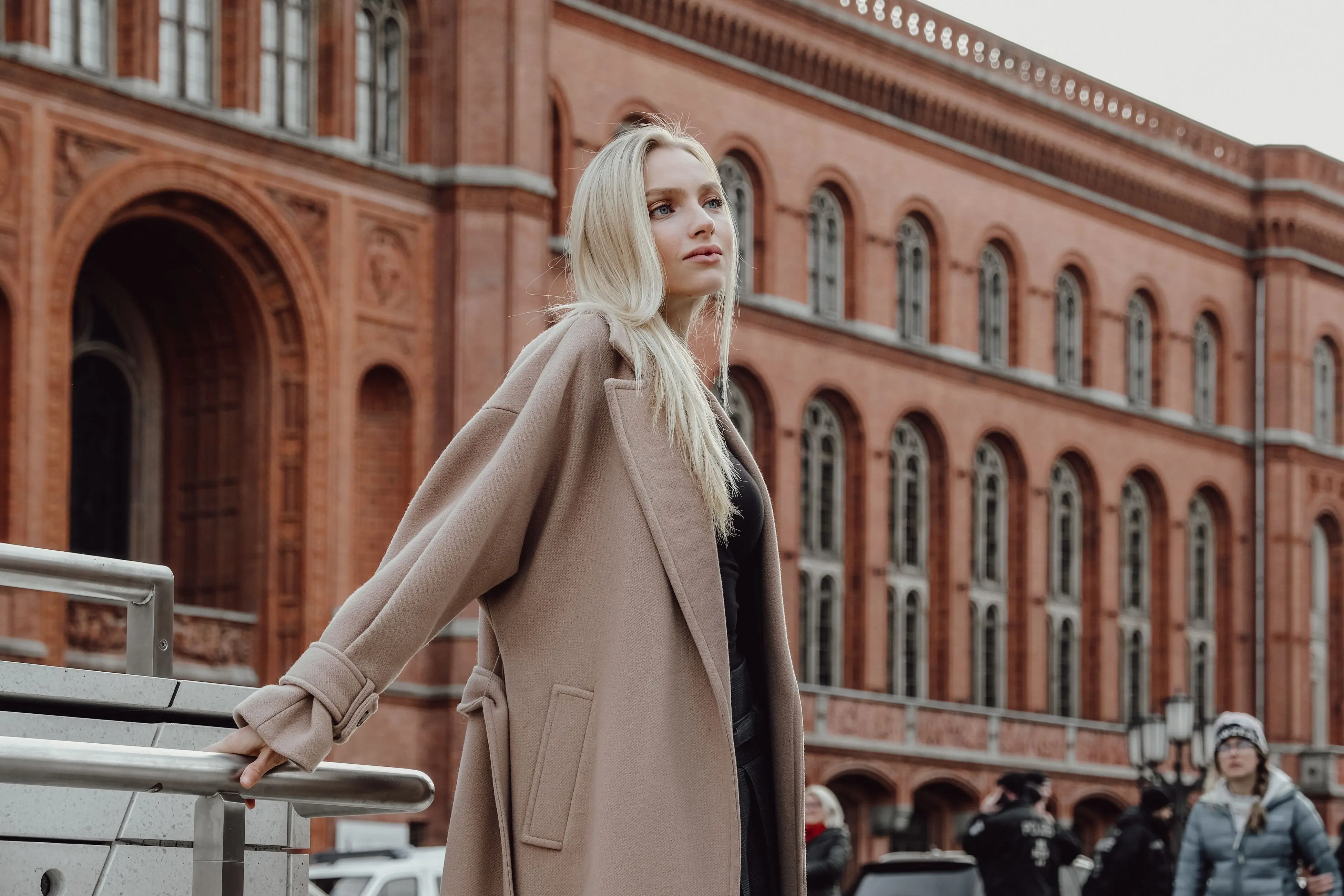
The long coat is one of those pieces that carries across seasons without going out of style, provided the cut and fabric are chosen well. Straight, fitted, oversized or wrap: each silhouette changes the way the piece is worn and paired with the rest of a wardrobe. It is also a piece that calls for a bigger budget than a simple jacket, which is a good reason to take the time to compare cuts, fabrics and finishing before buying one. Here is how to find your way through it, from cut to care, by way of fabrics and the details that make the difference.
Long coat for women at a glance
| Cut | Silhouette | Particularly suits |
|---|---|---|
| Straight | Clean lines, not fitted at the waist | Everyday wear, easy to layer over a thick jumper |
| Fitted | Marked at the waist, often with a belt | Anyone looking to emphasise their silhouette |
| Oversized | Roomy, wide sleeves, sometimes without a structured collar | A relaxed style, worn over a lighter outfit |
| Wrap | Double-breasted, front panels that overlap | A dressier look, close to a trench or a long pea coat |
| A-line or cocoon | Flared at the hem or rounded at the shoulders, barely fitted | An enveloping silhouette, without marking the waist |
Coats for women: straight, fitted, oversized or wrap
A straight cut remains the easiest to pair: it does not mark the waist, falls cleanly along the body and layers easily over a thick jumper or a light jacket, which makes it a good choice for everyday wear. A fitted cut, on the other hand, takes in the waist, sometimes with a belt to tie or buckle, for a more defined silhouette.
The oversized cut, very present in recent seasons, is recognisable by its wide sleeves and overall volume: it is worn over a more fitted outfit, to balance the proportions. One practical point worth checking on this type of cut is the depth of the armholes: armholes that are roomy enough let you layer a thick jumper or a jacket underneath without pulling at the shoulders, which makes a real difference in the depths of winter.
A wrap cut, with its double-breasted front and overlapping panels, gives a dressier result, inherited from the trench coat and the long pea coat; it also blocks more wind at the chest than a single-breasted cut. Finally, an A-line or cocoon cut, flared at the hem or rounded at the shoulders, wraps the body without ever marking the waist, for a more relaxed look. These five cut families are not mutually exclusive: the same coat can, for example, combine a straight base with a removable belt, moving from a relaxed look to a fitted silhouette depending on the day.
What length to choose for a long coat
Length is chosen first according to your own build, more than any universal rule. A coat described as “long” generally falls below the knee, while a mid-length coat stops around mid-thigh or just above the knee. The longest styles, sometimes called maxi, graze the ankle: they give an elongated silhouette, but can add a shortening effect on a smaller frame if the hem falls too low.
For everyday use, a hem that stops at the calf remains the most versatile choice: it leaves enough freedom of movement for walking or taking public transport, while keeping the enveloping effect that defines a long coat. Trying it on remains the best way to judge: the same length in centimetres does not look at all the same depending on the height of the person wearing it.
Shoulder width and sleeve length also deserve attention, especially on an oversized style: dropped shoulders that are well suited to your own frame avoid the look of a borrowed coat, while sleeves that cover the wrist down to the base of the hand give better protection from the cold on walks outside. On ranges that offer several sizes, trying two neighbouring lengths before settling on one often helps spot the most flattering cut for your silhouette.
Fabrics and wool: virgin, blended, double-faced
Fabric remains the most decisive factor for warmth and how well a long coat holds up over time. Virgin wool, meaning wool that has never been recycled or blended with other fibres, generally offers the best insulation and the cleanest drape. Many coats on the market are nonetheless made of blended wool, combined with cashmere for softness, with silk for shine, or with fibres such as lyocell or polyester to lighten the fabric and lower the price.
Double-faced wool refers to a particular weave or felting process that gives a finished look on both sides of the fabric, rather than one neat face and a raw reverse. This treatment often removes the need for a classic lining, which lightens the coat and gives it a softer drape. It is found in 100% wool compositions as well as in wool-and-cashmere or wool-and-silk blends, without a higher price alone guaranteeing the quality of the weave: the composition stated on the label remains the most reliable clue, ahead of price or brand.
Two simple checks help judge the quality of a wool fabric in store: weighing it in your hand, since a dense fabric drapes better than one that is too light for its length, and lightly crumpling it to see how quickly it springs back into shape, a sign of a fibre that holds up well. Coats that include a share of synthetic fibres such as polyester remain a reasonable choice for a tighter budget or occasional use, provided they still contain enough wool to keep a decent level of insulation in the depths of winter.
For a softer, more textured wool, our guide to cashmere explains how to recognise a good fibre, criteria that also apply to coats that contain a share of it.
The details that change everything: belt, hood, collar
Beyond cut and fabric, several details change how a long coat looks and how it is used. A belt, tied or buckled, lets you cinch the waist on an otherwise roomy coat, shifting from a relaxed look to a more structured silhouette depending on how it is worn. A hood, when removable, adds a practical function without visually weighing down the collar on days it is not needed.
The collar also makes a real difference in use: a stand-up collar gives better protection from wind and cold, while a notched or tailored collar, more open, shows off a jumper or a scarf and gives a dressier result. A faux-fur collar, removable on some styles, adds a warm touch for the coldest days without stopping the coat being worn collar-bare the rest of the season.
Buttons and pockets also matter for everyday use, even if they draw less attention than cut or colour. Piped pockets, set into the seam rather than patched on the surface, keep a cleaner line; deep pockets, meanwhile, make the coat more practical for slipping in gloves or a phone. On buttons, sturdy stitching and a slightly larger-than-average size are generally easier to handle with gloves on, a detail that matters most on a coat worn all winter.
How to wear and style a long coat
A straight or oversized long coat works as well over jeans and boots as over a light dress, playing on the contrast between the coat’s volume and a more fitted outfit underneath. Colour also affects how the piece fits into an existing wardrobe: neutral tones such as camel, beige, grey or black pair with most outfits, while a checked coat or one in a bolder colour works as a statement piece, meant to be the focal point of the outfit.
For a complete winter look, footwear also changes how a long coat reads: tall boots extend the vertical line created by the coat, while loafers or trainers balance out a more relaxed outfit. Our round-up of this season’s autumn-winter trends looks at the pieces and colours that pair best with a long coat this year.
A long coat is also a piece meant to be kept for several seasons, rather than a basic renewed every year, so a well-considered choice of fabric and cut matters more than the trend of the moment. For a broader look at what sets apart a piece built to last from something more disposable, our overview of designer ready-to-wear explains what defines a designer piece, coats included. To compare several places to find this kind of piece, our comparison of women’s designer clothing sites brings together several retailers.