
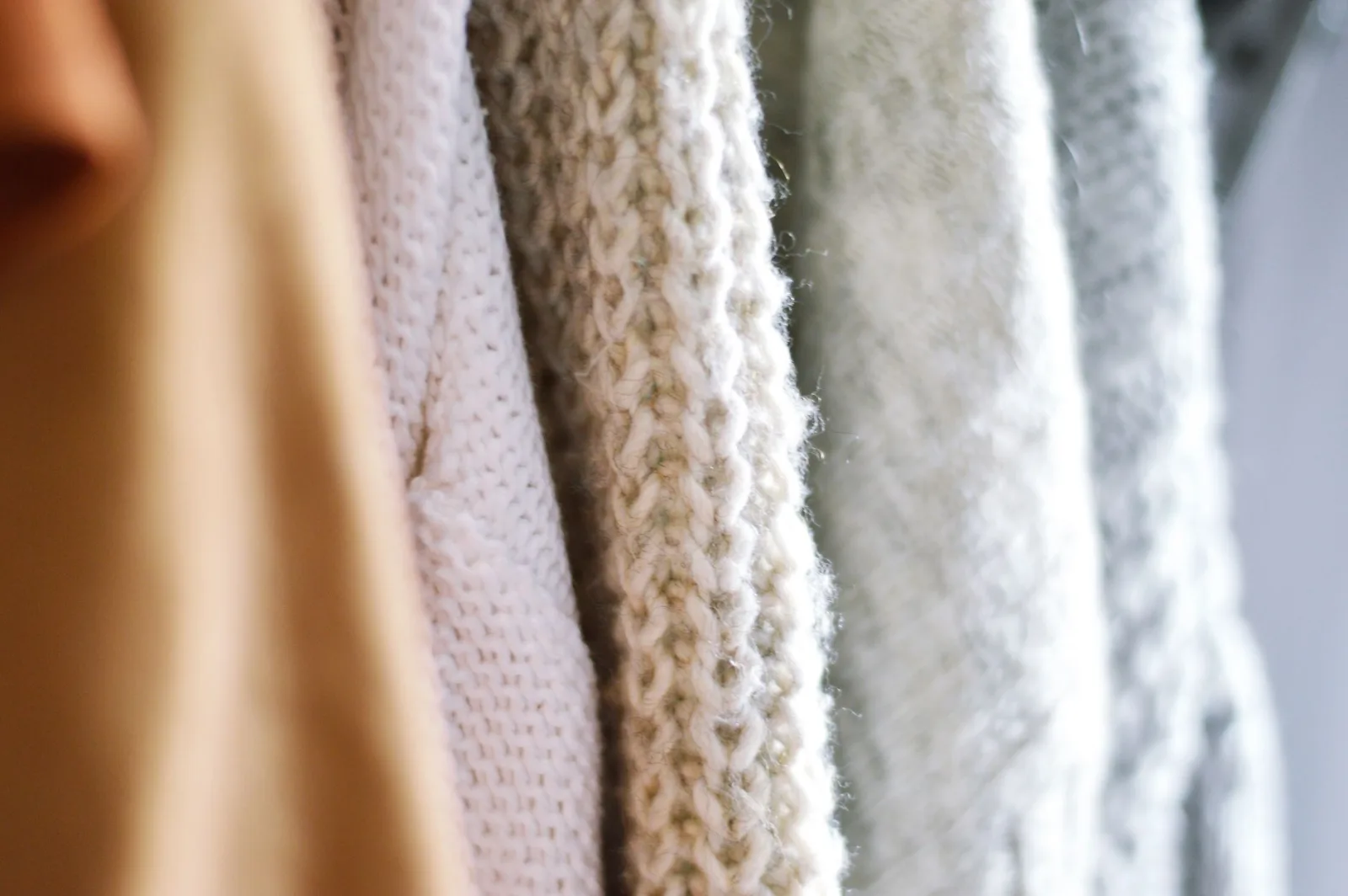
Good cashmere is recognised first by its fibre: fine, long and well sorted. Everything else, ply, colour, cut, comes after. This guide sets out the cues for judging a sweater before you buy it, based on what can actually be checked: the legal definition, the label, the knit and the hand.
What exactly is cashmere?
Cashmere is the undercoat down of the cashmere goat (Capra hircus laniger). The animal grows two layers: long, stiff outer guard hairs that shed snow, and beneath them a very fine down that keeps it warm through the winters of the high plateaus. Only that down becomes yarn.
It is harvested in spring, during the moult, by combing or shearing depending on the herd. Quantities are small: the Discover Natural Fibres Initiative, a programme that grew out of the FAO’s International Year of Natural Fibres, puts it at around 150 g per animal per year.
In regulatory terms, it is not wool. The EU regulation on textile fibre names lists cashmere among fine animal hairs, alongside alpaca, llama, camel, mohair, angora and yak. The label may read “cashmere”, “cashmere wool” or “cashmere hair”.
Where does cashmere come from, and where does the name come from?
The name comes from the Kashmir region in the Himalayas, where shawls were woven for export to Europe. The raw fibre itself already came from the high plateaus of Central Asia. Europe discovered these shawls at the end of the 18th century, after Napoleon’s Egyptian campaign, and Empress Joséphine made them a sought-after accessory. In the early 19th century, French industrialists tried to raise the goats at home. The animals did not adapt, but the know-how stayed: the first French cashmere spinning mills were founded by Jean-Baptiste Decrétot in Louviers and by Baron Ternaux.
Today production is concentrated in China and Mongolia. The DNFI estimates the world harvest at 15,000 to 20,000 tonnes of raw down, or around 6,500 tonnes of pure cashmere once scoured and dehaired. China supplies roughly 10,000 tonnes of raw fibre, Mongolia about 3,000. That scarcity, set against the volumes of sheep’s wool, is what drives the price of the fibre.
Fineness in microns, the first quality criterion
Cashmere quality is measured first by fibre diameter, expressed in microns (thousandths of a millimetre). The finer the fibre, the softer it feels and the lighter the yarn can be.
The United States regulates the word most precisely. Under the Wool Products Labeling Act, a “cashmere” label is misleading when:
- the fibre is not the dehaired undercoat of a cashmere goat;
- its average diameter exceeds 19 microns;
- more than 3% by weight consists of fibres over 30 microns;
- the coefficient of variation around the mean exceeds 24%.
For reference, the DNFI notes that the finest grades come in at around 14 microns. The EU regulation sets no fineness threshold: it requires an accurate fibre name and reserves “100%” or “pure” for single-fibre items, with a 2% tolerance for extraneous fibres, raised to 5% after carding.
In practice, few brands publish the micron count of their yarn. When they do, it is useful information. When they don’t, fibre length and how the knit holds up give you clues.
Fibre length and pilling
A long fibre spins better: it twists on itself with fewer loose ends, giving a more even yarn that stands up better to friction. Short fibres leave more ends sticking out, which tangle and form pills.
Pilling alone is therefore not a verdict. Any natural fibre knit pills a little at first, under the arms, at the cuffs, wherever a bag rubs. What should worry you is heavy pilling from the first few wears, often a sign of short fibres or a knit that is too loose. Recycled cashmere, made from fibres that are shredded and respun, generally has shorter fibres than virgin cashmere: that is a limitation worth knowing, not a hidden flaw, and its composition must be stated.
Ply and gauge: thickness, not quality
Ply is the number of strands twisted together to make the knitting yarn. A 1-ply gives a very fine knit, 2-ply the most common knit, 4-ply or more a thick, warm one. It tells you about thickness and the amount of yarn, and so partly about price, but not about fibre quality: a 4-ply made of short fibres is still mediocre cashmere.
Gauge is the number of needles per inch on the knitting machine. A high gauge makes a tight, fine knit, a low gauge a chunkier, more visible stitch. At the same gauge, density is what matters.
| Cue | What it tells you | What it doesn’t |
|---|---|---|
| Microns | Fibre fineness, hence softness | How durable the knit is |
| Fibre length | Resistance to pilling | How thick the sweater is |
| Ply | Thickness, warmth, amount of yarn | Fibre quality |
| Gauge | How fine the knit is | Fibre quality |
| “100% cashmere” | A single fibre, 2% tolerance in the EU | Fineness or origin |
How to judge a cashmere sweater in a shop
Without a laboratory, a few simple checks give you a good idea:
- Read the composition label. An exact percentage, any recycled cashmere and any blend (wool, silk, polyamide) are information you are owed. “Cashmere” with no percentage is not a composition.
- Hold it up to the light. A dense knit lets little light through. A knit that is open in places or uneven will lose its shape faster.
- Gently stretch an area, then let go. The knit should spring back. If it stays slack, the knit is too loose.
- Rub the surface lightly. Long fibres stay smooth. If small fluff appears straight away, the fibres are short.
- Check the finishing. Firm ribbing at cuffs and hem, linked rather than overlocked seams on carefully made pieces, a stated place of manufacture.
Touch is not enough: a softening finish or wash can make a mediocre yarn feel very soft on the shelf, then pill after a few washes. It is the combination of cues that counts, as with any piece of designer ready-to-wear whose making you want to assess.
Caring for cashmere so it lasts
Cashmere should be washed rarely and gently. Manufacturers’ advice is consistent:
- hand wash or use the wool cycle, in cold or lukewarm water, with a wool detergent;
- no rubbing, no wringing, press the water out in a towel;
- dry flat, never on a hanger or in a tumble dryer;
- store folded, protected from moths with cedar or lavender;
- remove pills with a cashmere comb, without pulling at the knit.
Between wears, a sweater aired flat recovers its shape. Watching it closely in the first few weeks also lets you check what the label promised.
Where cashmere fits in a designer wardrobe
Cashmere remains a staple in the best sense: a sweater, cardigan or scarf you keep for years if the fibre is good. Independent designers often work it in small runs, sometimes blended with wool or silk to change the hand. To compare cuts and compositions side by side, a designer concept store lets you handle several labels in one place. To get a sense of prices and return policies, our comparison of women’s designer clothing sites offers benchmarks, and the Ready-to-wear section gathers our other fabric and garment guides.