
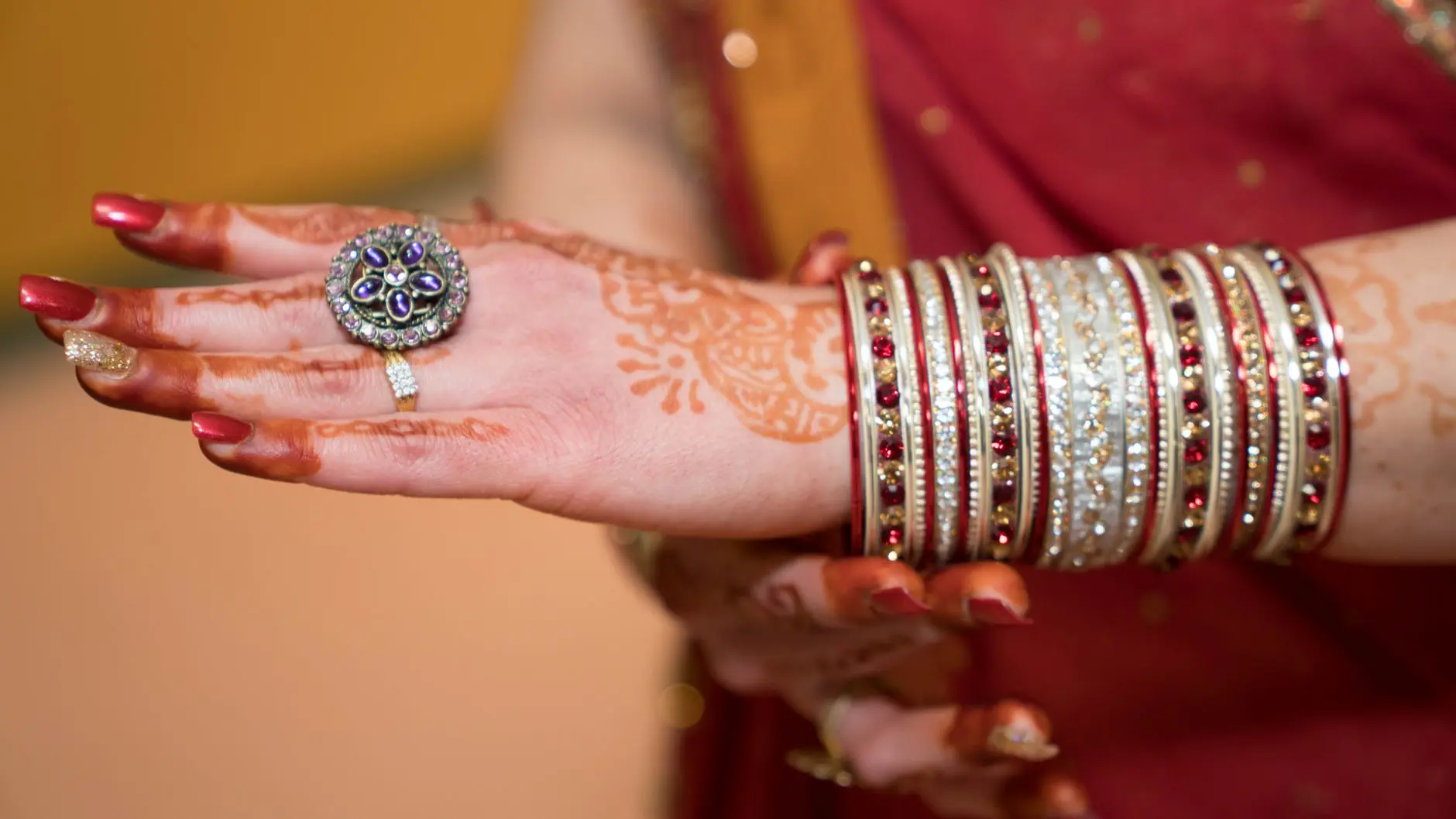
A bangle bracelet is easy to spot by its rigid band, worn alone or stacked with other pieces, with no visible clasp as on a chain. Behind the name sit several shapes (closed, open or hinged) and several materials, from solid gold to stainless steel. Here is how to tell the different bangles apart, choose the right size and look after yours, whether you wear it alone or piled up with other bracelets.
Bangle bracelet: the shapes at a glance
| Shape | Feature | Fit on the wrist |
|---|---|---|
| Closed bangle | A single unbroken rigid ring, fixed diameter | Slides on over the hand, flat |
| Open bangle | A rigid band with a gap, slightly flexible | Opens to pass the wrist through |
| Hinged bangle | Two halves joined by a spring-loaded clasp | Opens like a watch strap |
The choice between these three shapes mostly comes down to the size of your hand relative to your wrist: a closed bangle has to be wide enough to pass over the hand, while an open or hinged model fits directly onto the wrist.
The bangle bracelet, a definition
The French word for the piece, jonc, comes from the Latin juncus, which names a plant in the rush family, with tall, straight, flexible stems that grow in water or very damp ground. The Dictionnaire Le Robert notes that the word took on, mainly in Quebec, the sense of a ring, band or bracelet. The word bracelet itself comes from Old French bracel, a diminutive of bras (arm), from the Latin bracchium: literally a little arm, or what goes around the wrist.
In jewelry, a bangle bracelet is a rigid band, usually round, square or domed in cross-section, that goes around the wrist with no chain or links. Unlike a chain bracelet, it has no flexible joints or multi-ring clasp: its rigidity is its whole character, and it is exactly what lets it be stacked without tangling with its neighbours.
Bangle, cuff, chain bracelet: telling them apart
A bangle is different from two other families of bracelet it is sometimes confused with. A cuff is also rigid, but wider and open at the front: it wraps around a good part of the forearm rather than just the wrist. A chain bracelet, on the other hand, is flexible: linked segments joined into a chain and closed with a clasp, which makes it closer to a classic chain bracelet than to a bangle.
A bangle is worn alone, as a sculptural piece, or stacked with several others: this ability to be stacked, with no clasp to get tangled, explains the popularity of the open or semi-rigid model, which is easier to take on and off several times a day than a closed bangle.
Common materials for a bangle
As with any piece of jewelry, the material decides the price, the care it needs and how well it holds up over time.
- Gold (yellow, white or rose): in France, the name requires a fineness of at least 375 parts per thousand (9 carats), the minimum set by the General Tax Code for the right to use the word “gold”; 585 (14 carats) and 750 (18 carats) are also common, recognisable by their respective hallmarks (a clover, a scallop shell, an eagle’s head).
- Solid silver: a silver alloy at the legal fineness, most often 925 parts per thousand, known as “sterling silver”. It tarnishes with air and moisture and needs cleaning more often than gold.
- Gold plating: a base metal coated with a layer of gold at least 3 microns thick, at a fineness of at least 500 parts per thousand, under article 212 A of appendix III of the General Tax Code. The layer wears away over time, which is why it helps to take the piece off for the shower, sport or swimming; our guide to gold plated, vermeil or solid gold covers these thresholds and the hallmarks to look for on a solid gold piece.
- Stainless steel: an alloy that resists water and oxidation with no particular care, sometimes coated in gold by a process called PVD. A common choice for a bangle worn every day with no special precautions.
For a gold bangle, our comparison of gold jewellery for women brings together several designer addresses.
Some bangles also carry a row of set stones: diamonds on the most precious pieces, cubic zirconia (a synthetic stone with a sparkle close to diamond) on more affordable versions. Cubic zirconia is not a regulated name the way gold or silver is: its use is entirely up to the designer, and it pairs just as well with silver as with gold plating.
Choosing the right bangle size
An open or hinged bangle adjusts a little, but a closed model, which slides on over the hand, needs a precise size: too small, and it will not pass over the hand; too large, and it spins on the wrist and eventually slides off.
To find your size, measure your wrist circumference with a soft tape measure, placed just below the wrist bone, without pulling it tight. Then add a comfort margin, usually about one centimetre for a loosely worn piece. The bracelet’s inner diameter equals the circumference you measured, divided by π (about 3.14): a 17 cm wrist circumference, plus a one-centimetre margin (18 cm in total), gives an inner diameter of about 5.7 cm.
If you already own a bangle that fits, measure its inner diameter directly to find the equivalent at another designer: sizes are not standardised from one maker to another, and an S at one brand can match an M at another.
Wearing a bangle alone or stacked
A wide, detailed bangle (a twisted, domed or set pattern) can stand on its own, worn alone on a bare wrist: the most understated choice, letting the piece speak for itself without competition.
Stacking, by contrast, plays on number and contrast: several thin bangles, in slightly different widths, generally work better together than one wide model doubled with another. Mixing materials, gold and silver for example, remains a deliberate style choice, as long as you keep some consistency, polished finishes throughout or matte finishes throughout rather than a mix of both. A wrist that already wears several rings generally suits a lighter stack better, since a dense one risks catching on sleeves.
Slipped into a gift list, a thin bangle suits Christmas as well as a birthday: our guide to Christmas gift ideas for women brings together several addresses by style, jewelry included.
Caring for your bangle day to day
Care depends above all on the material chosen above:
- clean gold and silver with warm soapy water, using a soft brush, then dry with a lint-free cloth;
- for silver, an anti-tarnish cloth or a suitable paste removes oxidation without scratching the metal;
- for gold plating, avoid abrasive products and take the piece off before the shower, sport or swimming, to preserve the gold layer;
- for stainless steel, cleaning with soapy water is enough, with no particular precaution against water or sweat;
- whatever the material, take your bangles off before sport, gardening or washing dishes: a rigid bracelet knocked against a hard surface scratches faster than a flexible piece;
- a bangle set with stones, diamond or cubic zirconia, also avoids ultrasonic cleaners, which can loosen a poorly set stone; a simple soft cloth is usually enough.
A well-chosen bangle, in the right size and material, lasts for years, worn alone or multiplied on the wrist as the mood takes you. To match it with a birthstone or another piece from the same family, our birthstone guide covers the month-by-month calendar, useful for personalising an engraved bracelet.